Currently Empty: ₹0.00
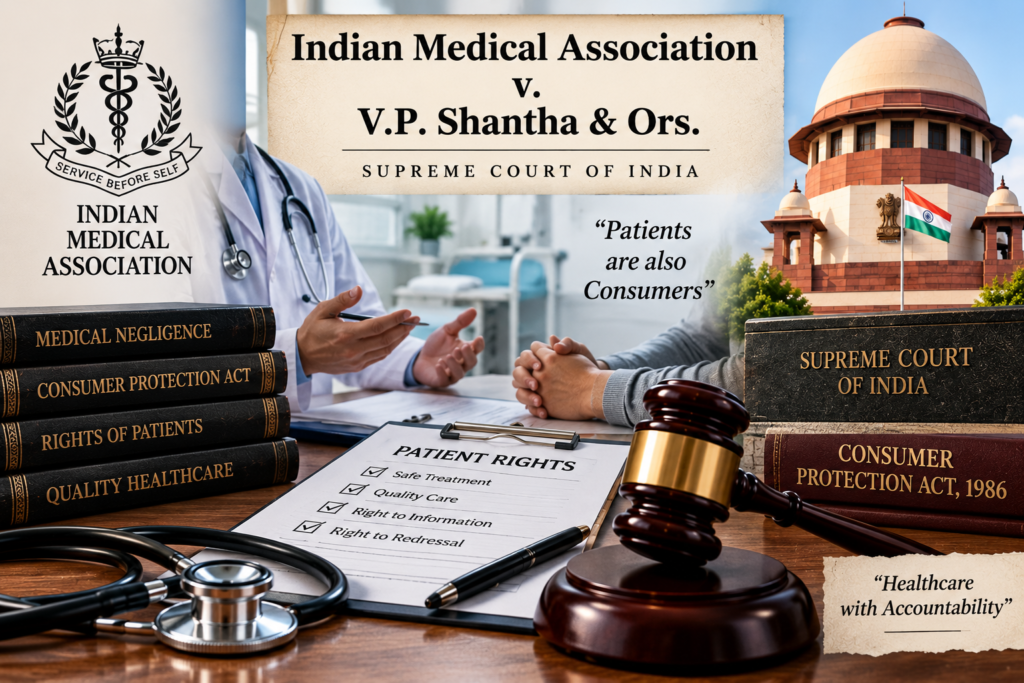
Indian Medical Association v. V.P. Shantha & Ors.
1996 (6) SCC 651 | Supreme Court of India | 13 November 1995
Understanding Medical Services, Consumer Status and Deficiency of Service
Can a person who pays for medical treatment be considered a consumer under consumer protection law?
And does a doctor or hospital provide a “service” within the meaning of the Consumer Protection Act, 1986?
In Indian Medical Association v. V.P. Shantha, the Supreme Court examined whether medical practitioners and hospitals fall within the definition of “service” under the Consumer Protection Act, 1986. The Court held that medical services rendered for consideration are generally covered by the Consumer Protection Act. A patient who pays for medical treatment can therefore be a consumer, and a doctor or hospital may be liable for deficiency in service.
However, the Court also recognised an important distinction between:
- Services provided for consideration;
- Services provided completely free of charge; and
- Services forming part of a contract of personal service.
The judgment became one of the foundational decisions connecting medical negligence with consumer protection law.
1. The Case in Brief
Case: Indian Medical Association v. V.P. Shantha & Ors.
Citation: (1996) 6 SCC 651
Date of Judgment: 13 November 1995
Court: Supreme Court of India
Bench: Justice S.C. Agrawal, Justice Kuldip Singh and Justice B.L. Hansaria
Principal Issue: Whether medical practitioners and hospitals provide “service” under the Consumer Protection Act, 1986.
2. What Happened?
Several questions arose concerning the treatment of patients by:
- private medical practitioners;
- private hospitals;
- nursing homes; and
- hospitals providing services either for payment or without direct payment.
The dispute arose because there was uncertainty regarding whether patients could approach consumer forums when they alleged negligence or deficiency in medical treatment.
The central question was therefore:
Is medical treatment a “service” under consumer law?
3. The Main Legal Issues
Issue 1
Does medical treatment constitute “service” under Section 2(1)(o) of the Consumer Protection Act, 1986?
Issue 2
Is a patient who pays for medical treatment a “consumer”?
Issue 3
Are completely free medical services covered by consumer law?
Issue 4
Can a hospital or doctor be held liable for deficiency in medical service?
4. What Did the Supreme Court Hold?
The Supreme Court held that medical services rendered for consideration fall within the scope of “service” under the Consumer Protection Act. Therefore, where a patient pays for treatment, the patient may qualify as a consumer.
The Court also clarified that services rendered completely free of charge to everybody would generally fall outside the Act. However, where free treatment is provided to some patients but the hospital charges other patients, the situation may be different because the institution is still providing services for consideration as part of its overall system.
5. Why Is This Important?
The judgment significantly expanded the practical reach of consumer protection law. A patient is not merely a passive recipient of medical treatment. Where treatment is provided for consideration, the patient may seek consumer remedies in cases involving:
- negligence;
- deficiency in service;
- inadequate treatment;
- failure to provide promised services; or
- other legally recognised deficiencies.
6. Relevant Legal Provisions
| Provision | Relevance |
| Section 2(1)(d), CPA 1986 | Definition of consumer |
| Section 2(1)(o), CPA 1986 | Definition of service |
| Section 2(1)(g), CPA 1986 | Definition of deficiency |
| Consumer Protection Act, 1986 | Legal framework governing consumer remedies |
7. Ratio Decidendi
Medical services provided for consideration constitute “service” under the Consumer Protection Act.
A person who hires or avails such medical services for consideration can qualify as a consumer and may invoke consumer remedies in appropriate cases of deficiency.
8. Why Is Judgment Important?
It brought medical negligence within consumer law.
The decision made consumer forums an important avenue for patients seeking remedies against medical negligence and deficiency in service. It also established an important principle:
Consumer protection is not limited to buying physical products.
Services can also create consumer rights.
9. Exam & Interview Corner
Q. Are all medical services covered under consumer law?
Not necessarily. The Court distinguished between services provided for consideration and services provided completely free of charge.
Q. Can a patient be a consumer?
Yes, where medical services are availed for consideration and the statutory requirements are satisfied.
Q. Why is V.P. Shantha important?
Because it recognised medical treatment for consideration as a “service” under the Consumer Protection Act.
10. Legal Terms Made Simple
Consumer: A person who purchases goods or hires/avails services for consideration.
Service: A service made available to potential users, subject to statutory exclusions.
Deficiency: Fault, imperfection, shortcoming or inadequacy in the quality or manner of performance of a service.
Medical Negligence: Failure to exercise the legally expected standard of care resulting in harm to the patient.
12. TARAJU TAKEAWAY
Indian Medical Association v. V.P. Shantha transformed the relationship between patients and healthcare providers by recognising that medical treatment provided for consideration can fall within consumer protection law.
The judgment demonstrates that consumer law protects not only purchasers of goods but also persons who pay for services.
Read our blog on the consumer rights.